Septic Tank Cleaning in New Braunfels
Septic tank cleaning in New Braunfels and nearby towns. More than a pump-out: removing hardened sludge and scum to restore your tank's full capacity.
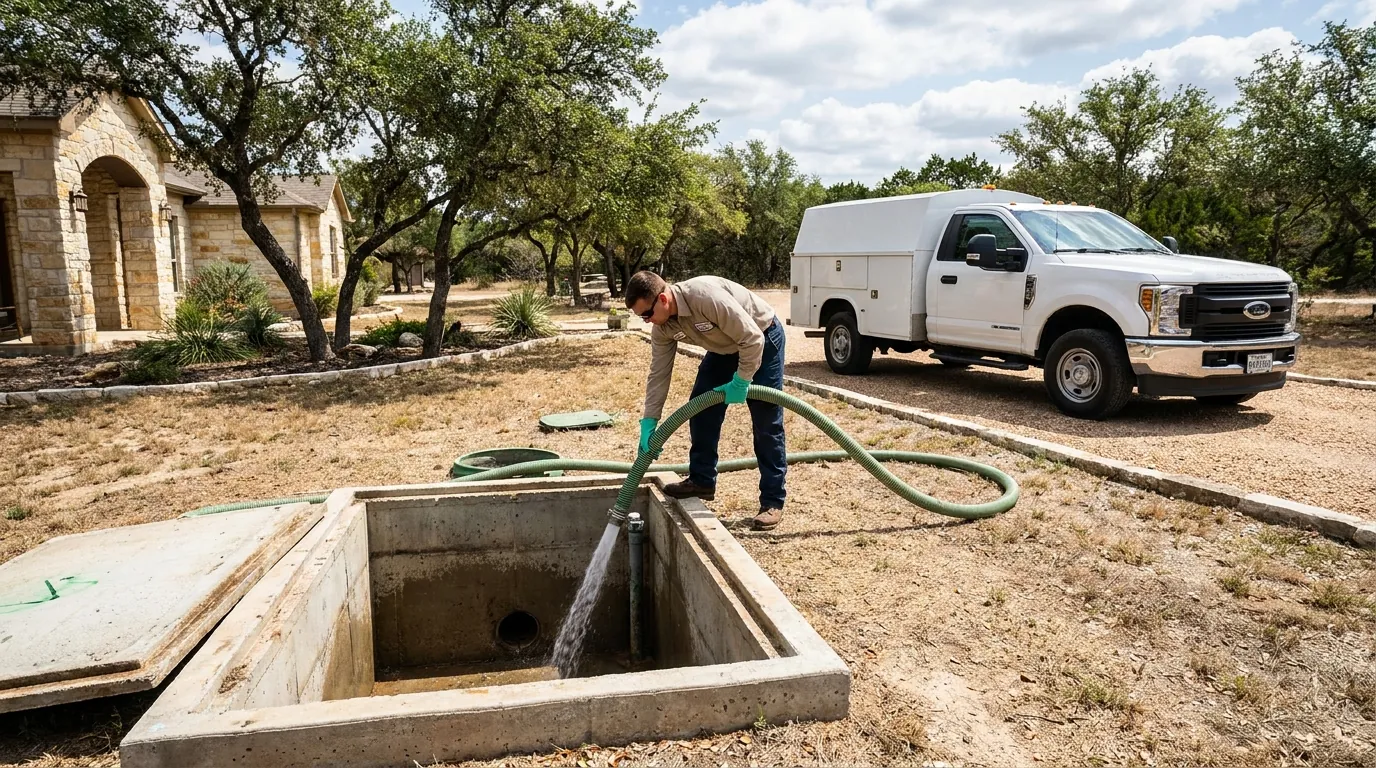
Cleaning versus pumping
People use pumping and cleaning to mean the same thing, but there's a real difference. A pump-out draws off the liquid and the loose sludge. Cleaning a septic tank goes further: it breaks up and removes the compacted sludge that hardens on the floor and the thick scum crust that builds over years, restoring the tank to close to its designed volume. If your tank hasn't been serviced in a long time, or has never been fully cleaned, that hardened layer may be stealing capacity a simple pump won't recover.
Why this matters more in New Braunfels: the slow-draining clay soils here punish a tank that's letting solids escape. When sludge builds past the outlet baffle, it washes out to the drain field, and a saturated clay field doesn't recover the way sandy soil does. Thorough cleaning keeps solids where they belong — in the tank, where they can be removed — instead of clogging the field.
If you're not sure whether you need a full clean or a routine pump, a septic system inspection settles it by measuring the layers. Many homes alternate: routine septic tank pumping most visits, with a deeper cleaning when the sludge has hardened.
How septic tank cleaning works
Cleaning a septic tank takes a few more steps than a routine pump-out.
-
Access and assess
We open both compartments and measure the layers so we know how much hardened material we are dealing with.
-
Remove the liquid and sludge
The tank is pumped down, drawing off the effluent and the loose sludge first to make room to work.
-
Break up compacted material
Hardened sludge on the floor and the scum crust are broken up and mixed so the vacuum can lift them out completely.
-
Clean to the tank floor
We continue until the compartments are clear down to the bottom, restoring the tank's designed volume.
-
Check baffles and close up
With the tank empty and clean, we inspect the baffles and walls, then backfill and note the condition for your records.
When cleaning pays off
A full cleaning is most worthwhile when a tank has gone years without service, when an inspection shows a deep hardened layer, or when you've had backups that suggest solids are building faster than a pump can keep up with. Homes in Schertz, Cibolo, and around Canyon Lake that have older concrete tanks are common candidates, especially where seasonal soil movement has stressed the tank.
After a thorough clean, keeping to a sensible pumping schedule prevents the sludge from hardening again. If cleaning reveals that solids have already reached the drain field, our drain field service is the logical next step to assess how much the field has taken on.
Frequently asked questions
What's the difference between pumping and cleaning a septic tank?
Pumping removes liquid and loose sludge; cleaning also breaks up and removes the hardened sludge on the floor and the scum crust. Cleaning restores more of the tank's original capacity, which matters when a tank has gone years without full service.
How do I know if my tank needs a full cleaning?
If it's been many years since service, if you've had backups, or if an inspection shows a thick hardened layer, a full clean is usually worthwhile. Measuring the layers is the only way to know for sure.
Will cleaning fix a slow-draining house?
It can, if the cause is a tank so full of solids that it's backing up. If the drain field is saturated or clogged, cleaning the tank helps but the field also needs attention. An inspection tells you which.
How often should a tank be cleaned rather than just pumped?
Many households pump on their normal schedule and do a deeper cleaning less often, when the hardened layer has rebuilt. The right rhythm depends on tank size, use, and how much your local soil stresses the system.
Talk to someone about your job
Call to describe the problem and get a quote for work in New Braunfels, TX.